
Research Focus
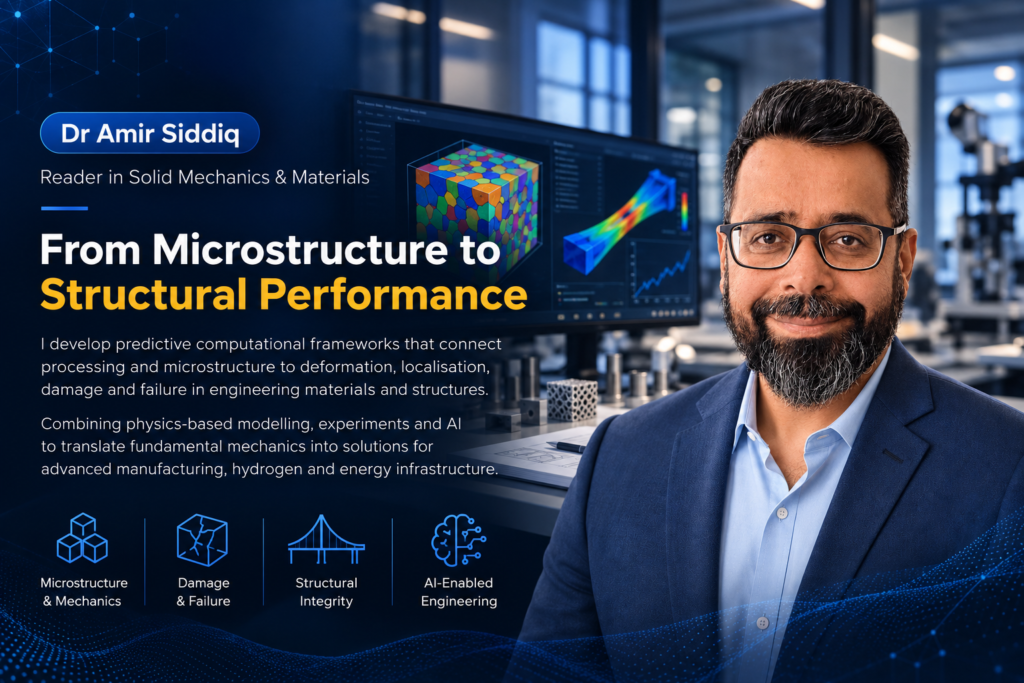
I am a Reader in Solid Mechanics & Materials at the University of Aberdeen, working at the intersection of computational mechanics, materials engineering and AI. My research seeks to understand and predict how processing, microstructure and environmental conditions govern deformation, damage and failure—and how this understanding can be translated into safer materials, manufacturing processes and engineering structures.
Over more than two decades across academia and industry, I have developed physics-based, multiscale and increasingly data-driven approaches spanning crystal plasticity, fracture and damage mechanics, advanced manufacturing, hydrogen–materials interactions and structural integrity.
My research philosophy is simple:
Understand the mechanisms → build predictive models → translate them into engineering decisions.
Impact Snapshot
100+
Peer-reviewed publications
£3M+
Research & innovation portfolio
Top 2%
Stanford/Elsevier global scientist ranking
20+ years
Academia & Industry
14+
PhD completions supervised
20+
PhD vivas examined
My work has been developed through collaborations with universities, national research centres and industrial organisations including EPSRC, NMIS/AFRC, Chevron, Shell, DNV, Apache, Seaway7 and international academic partners.
Research Programme
From Microstructure to Structural Performance
01
Microstructure → Damage & Failure
Understanding how microstructure, crystallography, defects and environment govern deformation localisation, damage initiation and fracture.
Crystal plasticity · β-Ti · Hydrogen · Damage · Fracture
02
Manufacturing → Material Performance
Understanding how manufacturing processes create microstructures, residual stresses and local material states that control component performance.
Forming · AM · Machining · Residual stress
03
Component → Structural Integrity
Translating material and mechanics understanding into assessment of real engineering components and infrastructure.
FFS · Pipelines · Offshore · Wind · Hydrogen infrastructure
Physics + Data + AI
An enabling capability across computational mechanics
01
Data-driven mechanics
02
Surrogate modelling
03
Uncertainty-aware prediction
04
Active learning
05
Self-learning computational mechanics
Selected Research Impact
From Research to Real-World Solutions
95%
Faster FFS Assessment
Automated API 579/ASME FFS workflows through PYSA, reducing assessment time by up to 95%.
100,000x
Faster Wind-Farm Layout Prediction
Machine-learning-assisted prediction of optimised wind-farm layouts.
Industry Translation
Manufacturing & Structural Integrity
Research with AFRC and industrial partners translating mechanics into right-first-time manufacture and engineering decisions.
Current Research Directions
Microstructure-Sensitive Failure Prediction
Connecting crystal plasticity, deformation localisation and damage mechanics to predict the initiation and evolution of fracture in advanced metallic materials.
Hydrogen-Assisted Deformation & Failure
Understanding how hydrogen transport, trapping, microstructure and plastic deformation interact to influence localisation, damage and embrittlement.
Identifiability in Computational Materials Mechanics
Investigating a fundamental question in constitutive modelling:
Which material parameters can actually be identified reliably from the experimental information available?
This research seeks to move calibration beyond finding a parameter set that reproduces a curve towards understanding whether that parameter set is physically identifiable and predictive.
Self-Learning Computational Mechanics
Developing computational frameworks in which machine-learning models quantify their own uncertainty, identify where new evidence is required, initiate additional simulations and progressively improve their predictive capability.
Digital Structural Integrity
Combining engineering mechanics, simulation, standards and AI to develop faster and more consistent approaches for Fitness-for-Service, pipeline integrity and structural assessment.
Academic & Research Leadership
I currently contribute to academic leadership across postgraduate engineering education, research, professional activities and industry engagement.
Current and recent roles include:
MSc Programme Coordinator
Advanced Mechanical Engineering and Advanced Structural Engineering
University of Aberdeen
Member — Advanced Manufacturing Thematic Leadership Group
Scottish Research Partnership in Engineering / National Manufacturing Institute Scotland
Hydrogen Theme Activities
Energy Technology Partnership, Scotland
General Council Member
Scottish Association for Metals
Research Peer Review & Evaluation
Including contributions to EPSRC and other national and international research funding and review activities
I have also previously served in programme leadership, employability, entrepreneurship and engineering education roles at the University of Aberdeen.
Career Journey
My research career has developed across industry, fundamental mechanics, advanced manufacturing and structural engineering, providing the foundation for my current interdisciplinary research programme.
Early Engineering & Industry
My early career included mechanical engineering, computational analysis and industrial research, establishing practical experience in engineering design, FEA and manufacturing.
University of Stuttgart | Robert Bosch GmbH | SKF
My work in Germany developed my expertise in computational mechanics, contact mechanics, diffusion modelling and engineering simulation.
Max Planck Institute | 2003–2006
As a Research Fellow, I worked on metal/ceramic interface fracture, crystal plasticity and cohesive-zone modelling, establishing the foundation for my subsequent research in multiscale deformation and failure.
University of Sheffield | 2007–2008
My research moved increasingly towards manufacturing mechanics, including thermo-mechanical modelling of ultrasonic welding and aluminium processing.
NED University | 2009–2010
As Associate Professor, I taught advanced engineering subjects including finite-element analysis, stress analysis and vehicle dynamics, while contributing to research development and academic leadership.
KAUST | 2010–2012
My research expanded into ultrasonic-assisted deformation, multiscale modelling, damage mechanics and advanced materials, with international collaborations including UC Berkeley and Oxford.
University of Strathclyde & AFRC | 2012–2014
As Lecturer/Assistant Professor and Adjunct Faculty at the Advanced Forming Research Centre, I worked on forming, machining, crystal plasticity, stress-corrosion cracking and industry-focused manufacturing research.
University of Aberdeen | 2014–Present
At Aberdeen, my research has increasingly connected materials mechanics, manufacturing, hydrogen, structural integrity and AI-enabled engineering, with research and innovation programmes involving EPSRC, industry and international collaborators.
This progression underpins my current research vision:
from microstructure → to material failure → to structural performance.
Professional Standing
CEng — Chartered Engineer
FIMechE — Fellow, Institution of Mechanical Engineers
FIMMM — Fellow, Institute of Materials, Minerals & Mining
SFHEA — Senior Fellow, Advance HE
These recognitions reflect professional standing across engineering practice, materials research, academic leadership and higher education.
Education
Dr.-Ing. / PhD — Mechanical Engineering
Max-Planck Institute & University of Stuttgart, 2006
MSc — Computational Mechanics
University of Stuttgart, 2003
BEng — Mechanical Engineering
NED University of Engineering & Technology, 1998
Postgraduate Certificate — Advanced Academic Studies
University of Strathclyde, 2014
Selected Recognition
Stanford/Elsevier — Top 2% Scientists Globally
Recognition through international citation-based assessment of scientific impact.
Knowledge Exchange & Commercialisation Award
Supporting translation of university research towards practical engineering applications.
Research Supervision Excellence — Nominations
University of Aberdeen
Teaching Excellence — Multiple Nominations
University of Aberdeen
Excellence in Leadership — Nomination
University of Aberdeen
Best Teacher Award
Automotive Engineering Department, NED University
Max Planck Research Fellowship
Max Planck Institute / University of Stuttgart
Professional Contribution
I contribute to the wider engineering and research community through:
Research funding and proposal review
EPSRC and international funding organisations
Journal and book reviewing
PhD examination
Professional engineering organisations
Conference scientific committees and research workshops
Industry and academic advisory activities
These activities allow me to contribute not only through my own research, but also to the development and evaluation of engineering research more broadly.
Beyond Research
Beyond research and teaching, I enjoy cricket, mentoring students and early-career researchers, and developing new ways of making advanced engineering knowledge accessible through digital platforms.
Professor 3MEC is part of this wider effort to translate specialist engineering knowledge into accessible educational and professional-development resources.
Collaborations & Opportunities
I welcome collaboration with researchers, industry and organisations working in:
Computational mechanics & FEA
Crystal plasticity & multiscale modelling
Damage, fracture & structural integrity
Advanced materials & manufacturing
Hydrogen–materials interaction
AI-enabled and self-learning engineering simulation
Offshore, subsea & energy systems
Opportunities include:
Joint research and funding proposals • Industrial R&D • PhD and postdoctoral collaboration • Technical consultancy • Visiting research • Invited lectures and seminars
From fundamental mechanisms to engineering impact.
Get in touch to discuss a research or industry collaboration.
Feedback & Reviews
Below are some of the feedback and reviews from my students and collaborators. For more reviews and feedback, please checkout my linkedIn profile.
“Dr Siddiq acted as my academic supervisor for my Renewable Energy Engineering MSc. I am very grateful for his support and expertise in Abaqus software, FEA and Wind Energy. Without his help I would not have been able to successfully complete me dissertation project.”
Harry Goodson
RWE Renewables
“I’ve had the pleasure of working on projects with Dr Amir during his courses in both “Subsea Integrity” and “Pipelines” at Aberdeen University. Above all, I was impressed by his ability to break down problems using basic and simple engineering mechanics. That skill often takes years to develop, and won’t be possible if not for his extensive knowledge in academia and expertise in the subject matter.”
Muhammad Hamizan
Baker Hughes
“I have known Amir for almost 10 years now and had the opportunity to collaborate with him during my Project work in University of Strathclyde. We worked together investigating the formability of Aluminium alloys by Incremental Sheet Metal Forming (ISF) process by experimental and Finite Element (FE) analysis. Based on the work, we could publish four peer reviewed publication. He was always available for discussion on the project topics despite his busy schedule in University. His knowledge in FE modelling of materials deformation from nano-scale to multi scale is extremely good. The results he produced during the project work were of highest quality in deformation and failure in ISF produced parts and their fracture initiation during forming.”
Rahul Bhattacharya
Ametek